Friday, October 30, 2009

Circles

DSC07228

This is an open question: What is this fractal? It's a method for filling a 2D plane with circles in an orderly way - circles made of circles, all the way down. There are published examples of similar systems, like the Apollonian Gasket, the Kleinian Groups, Indra's Pearls, but I've never seen this particular arrangement before, and I've been looking for over ten years. Is this a trivial variation on something already known? Or a new and undiscovered thing? I have no idea. I found it while doodling in math class.

fractal sketch

As a teenager in the 90s, my brain was warped and wrinkled by rave flyers, computer graphics, and pop science. I remember zooming in and out of the Julia Set on an Amiga 500 while still in middle school. In high school, these patterns were reinforced with heavy doses of techno music, Mondo 2000, and chaos theory. Hence the embarassing caption to the drawing above, which was made in college calculus class. At the University of Maryland, they wouldn't let anyone enter the architecture major without a B or higher in calculus. It took me three tries. If someone had sat me down and said "look, calculus is all about the always-imossible reconciliation between the grid and the curve, a constant becoming that has to get infinitismally small before its realization," then, I might've got it the first time round.

largeFRACTAL

When the architecture faculty introduced us to Autocad, one of the first things I did with it was to try drawing this thing accurately. The basic rule is to draw a circle around every intersection, which creates four more intersections, and so four more circles, always smaller than the last round. What I couldn't figure out in sketchbooks was whether or not the space left over would be circular too, and whether the centers of the circles were really precisely at the intersections, or shifted slightly. These questions were related - shifting the centers made for circular voids, but I couldn't decide if that was breaking too many rules, or if the whole thing really hung together like it seemed to.

FRACTAL cropped2

The trick that made it work was an inversion - in Autocad, it's impossible to draw the filled circles around the intersections first, without knowing where the centers really are, but it's possible to draw the voids first and work backwards from there. One of Autocad's many methods for drawing circles is as a three point snap. For any three points, there is one and only one circle that hits all of them - circumcircles, again. And luckily, one of the Object Snap (OSNAP!) settings is tangent to a curve; this means that you can easily draw a circle that's tangent to three other curves, without doing the math. Not that this drawing was easy, the image at the head of this post is a print from a .dwg with over 10,000 objects, the iterations are 9 levels deep.

DSC07011

This view of a hand drawn version shows the two types of circles, filled and void. The whole pattern could be made from either all filled, or all empty; the other kind is emergent from the constant reiteration of the one. The trick of drafting the thing by hand is again all about finding the right tools, and then reckoning. For the larger circles here, I improvised with a thumbtack and a piece of wire, the intermediate were drawn with a compass, the smaller were done with a circle template (always tricky to find one at the right radius), and the very smallest were filled in freehand.

rose cross process drawing 1

The hardest part of building the thing by hand is to find a center and a radius that will hit all of the adjacent circles at a tangent. In these drawings, I'm trying again and again to find some kind of geometric or proportional rule that will locate the next center point, and while there were a few promising patterns at the larger scale, they all broke down eventually, leaving trial and error as the only way through, but stll it works. That's why this is partially a plea to anyone else who might have more quantitative information about these geometries: help put this in context. What kind of thing is it?

2009-09-08 13.26.39

(for more process drawings, click here)

Tuesday, October 20, 2009

Closed Loop


closed loop, originally uploaded by ske765book.

Closed loop ecosystem diagram for a Stanford Torus space colony of 10,000. From T.A. Heppenheimer's Colonies in Space.

Tuesday, October 13, 2009

Mapping the D.center

dcentermap11dcentermap10dcentermap09dcentermap08dcentermap07dcentermap06dcentermap05dcentermap04dcentermap03dcentermap02dcentermap01

Organizational mappings for the D.center Baltimore, produced in the spring of '09 by Jillian Erhardt and Ryan LeCluyse, from MICA's Center for Design Practice.

Crossposted from the D.center blog, posting it here partly because I really like this set of diagrams, and I think they look great lined up in thumbnail form. It's interesting to note that, as is fitting for a quasiexistent entity, operating through a kind of applied decentralization, these diagrams are almost all reducible to some form of directional graph. And as such, they remind me of the work of Mark Lombardi, about whom I've been reading a lot lately, more to follow on that.

Saturday, October 03, 2009

Design Convo #12: BIKES

DesignConversation12_BIKES

Please join us for Design Conversation #12 : BIKES this Thursday evening.

Open discussion on frame building, bicycle design, bicycle infrastructure, bike collectives, bike lanes, and all things cycling. A/V system available for impromptu presentations. Free; cash bar. See attached.


Thursday October 8 2009
The Windup Space - 10 W North Ave @ Charles Street
6:30 pm - 8:30 pm


Questions? ben.stone@gmail.com | thewindupspace@gmail.com | blog.dcenterbaltimore.com

Please note that DC 12 has been shifted from the usual first Wednesday of the month to the first Thursday.

Saturday, September 26, 2009

Analog Voronoi Grid Distortion with Magnets

DSC06773

Using a magnetically distorted grid of washers as input sites for the Voronoi diagram.

Square Grid Distortion 01

(See also: How to: Draw the Voronoi Diagram)

Sunday, September 20, 2009

2009-09-20 21.01.44.jpg


2009-09-20 21.01.44.jpg, originally uploaded by sevensixfive.

Monday, September 07, 2009

How to: Draw the Voronoi Diagram

DSC05073

As has been written here before, Voronoi diagrams, as a geometric model are fascinating because they can be used to describe almost literally everything: from cell phone networks to radiolaria, at every scale: from quantum foam to cosmic foam. Even the regular lattices and solids, cubes, tetrahedra, and the ways in which they combine, can all be seen as special cases of three dimensional Voronoi. It's hard not to get mystical about it, but it's really just the contemporary equivalent of the endless ideal gridded space of modernism or the renaissance, just more exotic and malleable. Geometry is Culture.

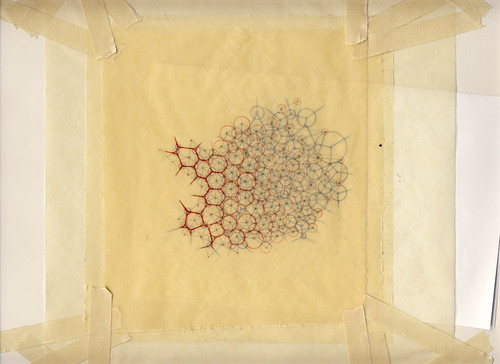
Drawing Voronoi diagrams by hand has renewed my interest in the stuff. There are lots of scripts out there for making instant vector crystal foam in just about any modeling or CAD platform, but it's more interesting for me right now to slow it down, take it step by step, and really try to understand the geometries involved. More a heuristic than an algorithm, executing it demands and reinforces the kind of zoned out close attention that almost becomes the whole point of drawing in the first place. The artifact that you get at the end it is just an unexpected bonus: the physical record left by the process of thinking out loud on paper. Below is a rough pseudocode (thanks, mike!) for building it up from a set of points.

VORONOI HOWTO
(1) Input Sites (2) Connect Nearest Neighbors (shortest line wins) (3) Find Center Points
(4) Draw Perpendicular Bisectors (5) Trace Cells (6) voila


(1) The input points, step one, are called sites, labeled here A, B, C, etc.

(2) The next step is to connect the sites to all of their nearest neighbors without making a line that crosses another. This is known technically as the Delauney Triangulation, and it's maybe the most difficult part. One way to do it might be by brute force - connect every site to every other site, make a true all-to-all rhizomatic meshwork, and then start deleting lines that are too long. This is how a machine might attack the problem, but it becomes too hard for a human to execute when the number of sites jumps into the double digits. Another algorithmic method is to start with a test triangle of sites and draw their circumcircle, the circle that hits all three sites, rejecting the triangle if the circle contains another site within it.


Image via wikipedia

This also takes too long, and circumcircles are hard to draw, so I found a method that's faster, and still mostly accurate. Since no lines on the Delauney triangulation can cross, just eyeball it until you run into a condition as in the above, where you have to decide if FD or AE is correct, the shorter line always wins. This is obvious in the example, but sometimes this needs some careful measuring in the field.

(3) Step three is to find and mark the centerpoint of every line on the Delauney graph.

(4) The fourth step is to draw the perpendicular bisector for each Delauney line. This is where careful accuracy, in finding the centerpoints, and in drawing a tight 90 degree angle, pays off. If everything has been done correctly, there will always be three lines converging at a point, unless the input sites are on a perfectly regular rectangular grid. Drawing the last line of the three and watching it land exactly where it's supposed to is extremely satisfying. Watching it miss can mean going back all the way to step two and flipping the Delauney graph for the triangle. Some mistakes are instructive, reminding you to take your time and think about the moves, but some are more interesting, for being completely inexplicable. A few places in these drawings, I've run into conditions that should work out, but just don't: evidence of some hidden monster in the process, a flaw in the heuristic, or a breakdown of the pseudocode.

(5) The fifth step is to retrace the outline of each Voronoi cell from the perpendicular bisectors. There will be one cell for every site, and at the end, each cell is just the set of all surface area points that are closer to its site than any of the other sites, as illustrated in the last panel: A' -> A, B' -> B, etc.

(6) Sit back and congratulate yourself while contemplating your hard earned tangle of fat distorted honeycomb.

DSC05123a

I've found in practice that it's best to use different colors for the input sites, the Delauney lines, and the bisectors, unless driving yourself completely crosseyed mad is something you have the time and inclination to do. Blue and red mechanical pencil leads are pretty easy to get. I made this drawing to practice, using a pepper grinder above the drafting table to get random input sites:

Artisanal Voronoi 1 SM

The wall drawing below was made for the Current Gallery's Abandon Ship show. It measures about 3' x 5'. The input sites here were the roughly patched holes and marks left by all the previous exhibits and shows in the space's three year existence as a gallery. Before that, the building was a chocolate factory. This piece will be demolished along with the rest of the show when (if) plans move ahead to build a hotel on the site. I was very glad to get the chance to do a wall drawing, having just visited again, for the second time, Sol LeWitt's ephemeral 'Drawing Series—Composite, Part I–IV, #1–24, A+B' at Dia Beacon. These pieces foreground the disconnect and shifts between the different types of time at play here: the almost instantaneous time of conception, the time spent to absorb the system, process the clues, unlock and understand the method, and the implied slow time spent to execute the drawing itself: a person, on a scaffold, pulling graphite repeatedly across painted gypsum. I wonder if the assistants were well paid.

DSC06027a

The five hours or so it took to carry out the Current Gallery piece were well spent: not an all nighter, but a late nighter. Friends brought food and beer, with other people coming and going, cutting holes in the building's floor, plastering the backside with xeroxed drawings, and making Seussian maggots crawl from the walls and ceiling.

[[Edit: If anyone else has tried this, put some pics of it on the web and post a link in the comments]]

[[[Edit 2: for more, see also: Analog Voronoi Grid Distortion with Magnets]]]

Tuesday, August 25, 2009

View Night Small


View Night Small, originally uploaded by ske765book.

Installation proposal for Axis Alley

Saturday, August 22, 2009

Anatomy of a Container Ship


Anatomy of a Container Ship, originally uploaded by ske765book.

Thursday, August 13, 2009

3000 years worth of Urban Form: A (too brief and easy) History

(partly from notes on the Urban Development as Counterinsurgency lecture by John Duda of the Baltimore Free School)

Grids as a simple way to control the landscape – Stars as a spiky outer shell – Cracks as the fabric within the shell is compressed and densified – Networks as this dense fabric is reopened and ventilated – Flows for the density to drain further – Softness of the regulatory and fiscal pressures that continue to drive the flow – Holes open up as the fabric is vacated … and now, the dominant formal strategy seems to be all about the infilling or refilling of those holes, along with the repurposing of the scrap left behind.

Sunday, August 02, 2009

Ailanthus


Ailanthus, originally uploaded by ske765book.

Sunday, July 26, 2009

Artisanal Parametrics

DSC06157

The Baltimore Development Cooperative (not to be confused with the Baltimore Development Corporation) has just won the 2009 Janet & Walter Sondheim Prize. The award represents regional and national recognition, and more tangibly, $25,000 in cash.

That a loose collective of recent graduates, whose major work to date is a community garden on a squatted vacant lot, can walk away with a prestigious regional art prize speaks to the current excitement and confusion in art, architecture, landscape, and planning.

Since the irrational exuberance of the mid-late aughties has peaked and popped, we're now in the middle of the inevitable backlash. Fires in China and labor strife in Dubai have become easy metaphors for the descendancy of an explicately formal and digital aesthetic, and by extension, an economic order whose agenda interlocked with it. And so the rise of work that claims a more direct engagement with social, economic, and evironmental justice. See, for example, NYTimes critic Nicolai Ourossoff: Architecture: It Was Fun Till the Money Ran Out, or activist design advocate Cameron Sinclair's The Architect's Dilemma: The Architecture of Excess vs. an Architecture of Relevance.

These journalistic cliches and reductive dualisms are a sadly predictable oversimplification of some complex territory. This is a disservice to the discipline. We can have excess and relevance (and fun) in architecture, whether there's money around or not.

It's been interesting to watch a similar discussion play out locally around the BDC's Sondheim win, with some questioning the presentation of interdisciplinary community organizing as museum quality art, and others questioning the legitimacy of the group's social engagement in the first place.

The major piece in their BMA show, The Dome, is an artifact that suggests there's more space, and fun, at angles to these simple oppositions than might be apparent at first. Bruce Sterling, in a post about the SmartGeometry conference, highlights the question:

"What happens when parametric architecture gets too cheap and too easy? Karrie Jacobs wonders. I think I already know, but it’s nice to see the issue being raised here. Note that the cover of this month’s METROPOLIS is a “twenty-thousand-dollar house” made out of scrap. Is there a reason that isn’t parametric technokitsch scrap yet? Yes… because it isn’t 2015 yet."


The piece, aside from its stated function as a Cultural Container (it's available for any individual or group to book for almost any purpose), is interesting as example of a kind of Artisanal Parametrics, hand made from scrap, but with the recognizable influence of the algorithmically geometric and digital.

DSC06156

Sunday, July 12, 2009

DSC06025a


DSC06025a, originally uploaded by sevensixfive.

Voronoi/Delauney wall drawing at the Current Gallery's Abandon Ship Show. Michael Benevento as scale figure.

Friday, July 10, 2009

Abandon Ship at Current Gallery


2009-07-09 20.39.13.jpg, originally uploaded by sevensixfive.

Abandon Ship! July 10 at Current
Abandon Ship Opening reception July 10, 7-10pm
Exhibition Dates: July 10 - Demolition, 2009, F-Su 11am - 3pm

MAYDAY MAYDAY MAYDAY... This is Current, Current, Current...Position 30 South Calvert Street, Baltimore, Maryland. Our vessel is going down! We require immediate assistance....All Hands on Deck!

Current Gallery, in conjunction with Off-Site Artscape, is proud to present Abandon Ship, an exhibition in preparation for the demolition of 30 South Calvert Street, curated by Michael Benevento, Monique Crabb, and Hans Petrich. For the past four years, Current has been a breeding ground for cultural production, opening onto countless collaborators, nourishing an ongoing conversation. Like a supernova before the collapse, we prepare for the building's demolition with an ongoing collaborative exhibition that embodies 30 South Calvert. Welcoming you moments before bulldozers consume the building, and we slither out the anus of the temporary shelter, like a colony of parasites discharged onto the city.
This is the last exhibition at 30 South Calvert, an ongoing collaborative installation, which will be demolished with the building (but not the last exhibition for Current).

Current Gallery is an artist-run gallery, studio, and performance space, located in downtown Baltimore. Operating since November 2004, we are committed to showcasing emerging artists and ideas.

Current Gallery
30 South Calvert Street
Baltimore Md 21202
www.currentspace.com

Wednesday, July 01, 2009

DC10_...


DC10_..., originally uploaded by D:center Baltimore.

Thursday, June 18, 2009

DSC05870a


DSC05870a, originally uploaded by sevensixfive.

Wednesday, June 17, 2009

Port Covington: The Ghost of the Masterplan in Tinkerer's Paradise

port covington REV2.011

In 1898, the city of Baltimore subsidized the creation of the Western Maryland Railroad, intended as an alternative that would compete with the high prices of the Baltimore and Ohio line, which had also been co-founded by the city over 70 years earlier. The two networks ran side by side without overlapping to terminals on the South Baltimore peninsula, where they both unloaded coal from Appalachia to ships that would take it up down the East Coast.

port covington REV2.010

Port Covington, the lower half of the South Baltimore peninsula, is today cut off from the rest of the city by Interstate 95. Historically, this site has always been a place with goods, people, and raw materials moving through it. Before an expansion of the city's boundaries in 1918, this was its southern limit. Light Street continued south to Brooklyn and Curtis Bay via a bridge that took off here.

port covington REV2.012

Then, as now, the spaces on the ground between these lines of connection and transfer were largely forgotten and undeveloped. In the 19th century, this area was the backyard and back door to the city of Baltimore, and like any backyard, this was a place for recreation and storage, comingled with trash and half-completed projects. The map above, part of a citywide topographic survey from 1895, shows rowing piers and resorts among the marshes, along with a dog pound, a guano pier, and a "night soil dump".

port covington REV2.014

The major landowner was the Winans family, who held a large estate situated up the Gwynns Falls from the port. This stream valley connection between these two pieces of property later became the right of way for the Western Maryland Railroad in the 1890s. And, after it narrowly missed becoming an expressway in the 1980s, it was turned into the Gwynns Falls recreational trail during the late 1990s, connecting the waterfront to the Winans Estate, now Leakin Park.

port covington REV2.016

The Winans were a family of engineers and entrepeneurs. Ross Winans had been sent to England by the B&O to study the state of the art in European rail technology. When he returned, it was as the lead designer for the new American railroad's rolling stock. Ross's other projects included a water wheel that powered the plumbing for the estate, and, during the Civil War, a steam powered machine gun.

sachse_winans cigar boat

This aerial view from 1869 shows Port Convington as a kind of tinkerer's paradise, with swamps, stockyards, chemical factories, and gas tanks. On the pier at Winans Cove, another of Ross Winan's projects is visible, a prototype Cigar Ship, the first all iron (not iron-clad) steamship in the country. Having solved the problem of efficient cross-country travel, the engineer had then tried to work out better ways to get people across the Atlantic.

Winans Cigar Boat

The Cigar Ships were symmetrical and tapered at both ends, with smokestacks in the center and a large waterwheel wrapping around the ship's waist. The first version was constructed here, with later models built and tested in London, St. Petersburg, and Le Havre. These were not submersible, they traveled on the surface of the water. As a piece of engineering, the design was impractical. But this ship may have had a greater influence in the cultural imagination, possibly inspiring Jules Verne's description of the Nautilus in 20,000 Leagues Under the Sea:

"Here, M. Aronnax, are the several dimensions of the boat you are in. It is an elongated cylinder with conical ends. It is very like a cigar in shape, a shape already adopted in London in several constructions of the same sort."

port covington REV2.020

The aesthetics of Baltimore's working harbor have evolved from this kind of 19th Century Steampunk Imaginary to the Romantic Decay of the present, but they've come here by way of the 1950s, the high water mark of the Industrial Sublime. Pictorial photographers, especially Aubrey Bodine, came to Port Covington to shoot artifacts like this roller coaster coal loader at the Western Maryland Railroad terminal, yards away from the last fragments of Ross Winan's pier.

Port Covington Coal Pier

This was the endpoint of a rail network that extended deep into coal country. The importance of that connection is underscored in this map: the name of the port, a neighborhood within the city of Baltimore, is printed larger than the name of Annapolis, the state capitol.

port covington REV2.026

The Western Maryland Railroad was bought out by its old competitor, the B&O, in 1983, and shut down soon after. Almost every trace of it at Port Covington has been erased in a cleanup of the site by the Maryland Department of the Environment. The major pieces that remain include a large trestle bridge over the outflow of the Gwynns Falls, and several derelict piers. One of these is now used as a berth for two MARAD ships, the military's ready reserve, part of a large network of ships waiting to deploy personnel, vehicles, and supplies anywhere in the world.

Port Covington Aerial w ships

The site is littered with big pieces: the piers, these ships, a factory that makes ceramic insulators, a power station. But the largest things here are the ghosts of failed masterplans. In the 1980s, the Baltimore Sun wanted to move their entire operation out of downtown. With the city's help, the Sun acquired an enormous piece of land in Port Covington, on the south side of 95. They moved the printing presses into a new building here, with Automated Guided Vehicles to transport the stacks of newsprint around the building, and then changed their minds. Now it sits surrounded by empty, well mown, grass fields. As of this writing, the Sun's paper circulation continues to fall, over 9% in the past six months, with a near 6% drop in the six months previous to that.
port covington REV2.038

The slow motion collapse of the Port Covington Shopping Center has left behind the most recent ghosts. In 2000, the Baltimore Development Corporation accepted a proposal from Connecticut retail development conglomerate Starwood Ceruzzi for the site. The city enabled the deal with tax incentives, rezoning, and an agreement giving the developer inculpablility from health hazards related to contamination. Starwood promised to bring a mix of retailers, and agreed to consider community recommendations to orient the buildings toward the water, and to "substantially enlarge the park area, incorporate walking paths, add sports fields, create picnic areas and include fishing and crabbing piers,". The city laid out roads, curbs, stop signs, streetlights, even fire hydrants, but Starwood Ceruzzi built only the Walmart and the Sam's Club, both with their backs to the water.

DSC02059a

In 2007, the Sam's Club closed, the building was painted gunmetal grey, ringed with security cameras, emptied, and put up for sale. The Baltimore Business journal quotes Starwood executive Arthur Hooper: "The final phase of development isn't something we were interested in doing, ... We're not long-term holders of projects. We brought in the big boxes. After that we're not in a position to deal with the local."

DSC05058

Ferry Bar Park, at the very southern tip of Port Covington is the remnant of a railroad right-of-way, it was given to the city in 1979. Some documents suggest that the park may have been encroached on by the shopping center's stormwater retention pond, a pond that, given the large amount of planned but unpaved area, my be unnecessary. The park is the site of the Baltimore Powwow, a largely undocumented yearly art and music festival, held to benefit the Arabber Preservation Society.


The continued existence of the Powwow, along with the presence of homeless camps (oriented toward the water) and ongoing illegal dumping at the site, suggest that if shopping center developers aren't in a position to deal with the local, then the local will, however imperfectly, deal with itself. Like the factories in the 19th century marshes, the adhoc uses are filling in the gaps between the bigger, broken pieces; with small scale occupancy, habitation, and transportation, leaving desire lines (and litter) threaded across the fenced lots.

DSC05234

The failure of the last laid plans is little deterrent to future projects, including at least one proposal that shows the existing Walmart gone, replaced by waterfront housing, and a new big box store relocated further inland.

port covington REV2.045

This is a site that is suspended somewhere between development and use, between stated intention, and actual condition. The gaps between overreach and underinvestment are filled in by the people on the ground. The empty parking lots are left to drifting plastic shopping bags and idling interstate buses. On sunny weekends, the derelict piers are covered with people, multiethnic families having picnics, playing the radio, and catching the fish that swim in the 150 year old piles of the Winan's Wharf.

DSC04095a

This is not to suggest some kind of schadenfreude at the failure of Grand Plans, or a naive love of Romantic Decay. This is to suggest that there are alternatives between the top-down of strategies masterplanning and the bottom-up tactics of the everyday. This is not a balance, more a productive, intermingling, dis-integration whose synthesis and realization can, like the Cigar Ship, occur more in the realm of cultural imagination than hard engineering.

Quayside

(This article is the fourth in a series on openspaces in Baltimore's Middle Branch. It is adapted from a workshop conducted as part of the City From Below conference in March 2009. For more information, see previous entries on Masonville Cove, Reed Bird Island, and Swann Park. This research was conducted with Eric Leshinsky and the Working-Group on Adaptive Systems. Thanks to Guy Hager of Parks & People for clueing us into the Winans Cigar Ship.)

Tuesday, June 16, 2009

How to Start a Design Conversation*

1) Ask a question. The best and most interesting conversations are usually about the things we don't know. To start, it's not necessary to have an idea about something, it may even be better to have no idea about something, and want to know more.

(Topics can come from all over the place. Design thinking is inherently inclusive, and the participants at these events so far have had pretty diverse backgrounds. Among other things, these conversations have been a chance to come along as people follow their own curiosities and obsessions in strange directions, ending up with unexpected connections, overlaps and resonances. Start anywhere.)

2) Bring it back to basics. It's useful to think about these things in the simplest possible way. How would you describe your interest to someone else? This could be in a way that's specific enough for them to know what you mean, but open enough for them to use and discuss in ways you might not expect.

(Some of the Design convos have had just one-word topic titles that can be read in several ways, like 'Food', 'Tools', or 'Waste'. Others, like 'Vacant Baltimore' or 'What's your Plan?' are direct enough that little other explanation is needed. More mysterious titles, like 'Cultural Containers' or 'Start Thinking Small' can reflect the curator's own uncertainty about the basic concepts in a way that presents an open question.)

3) Think out loud. Sometimes you don't know what you're going to say until you say it. Talking out things with other people is a good way to refine your own interest in the issue at hand, and a way to get others interested in it, too.

(The best way to see if you're onto something interesting is to find out if other people are into it, too. These events are built around conversation, and conversation is a good way to create and curate a topic for one. Talking about it with friends and strangers will help you clarify your topic, build energy and assemble the participants.)

4) Not an answer, but answers. A good talk is one we don't want to end, a discussion with a conclusion is over. If we give up using conversations to arrive at a destination, we can use them instead to explore a territory.

(Curating material for a conversation around a topic can be about giving up on preconceived end results. If you think you already know what's important about a topic, then inviting others to share their experience and interest is going to be redundant and frustrating. Accept at the start that things will go in multiple directions. This will allow everyone to find what they need in the discussion, and sketch out other threads to follow later.)

5) Frame it. Take a position, define a boundary. The larger the space is, the more important it becomes to know where you are, even if only as a starting point, for reference, variation, and disagreement.

(Accepting multiple answers doesn't mean that it's a good idea to remain totally neutral and relative all the time. This is a process that begins and ends with a kind of curious, energizing uncertainty, but in the middle it's useful to be confident and direct about where you are, and what you think is important.)


*The Baltimore Design Conversations are monthly events held the first Wednesday of every month in the Windup Space (12 W. North Ave.) at 6:30 pm. These events are open to the public and are loosely curated by volunteers around a series of topics related to design, art, architecture, cities, and whatever else is on your mind. Please join us. Cash bar and A/V hookup available.

For more information, visit the D. Center Baltimore flickr page and facebook group.

Thursday, May 28, 2009

DC9_PROJECTS

Saturday, May 09, 2009

supermicromegainfra


supermicromegainfra, originally uploaded by ske765book.